Palm Jebel Ali: Dubai's AED 35 Billion Mega Island Is Back| Should You Buy Now or Wait?
Palm Jumeirah changed Dubai forever. It turned a strip of desert coastline into the most recognizable man-made island on Earth and created billions in property value from nothing but sand, vision, and engineering.
Now the same developer is doing it again. Bigger.
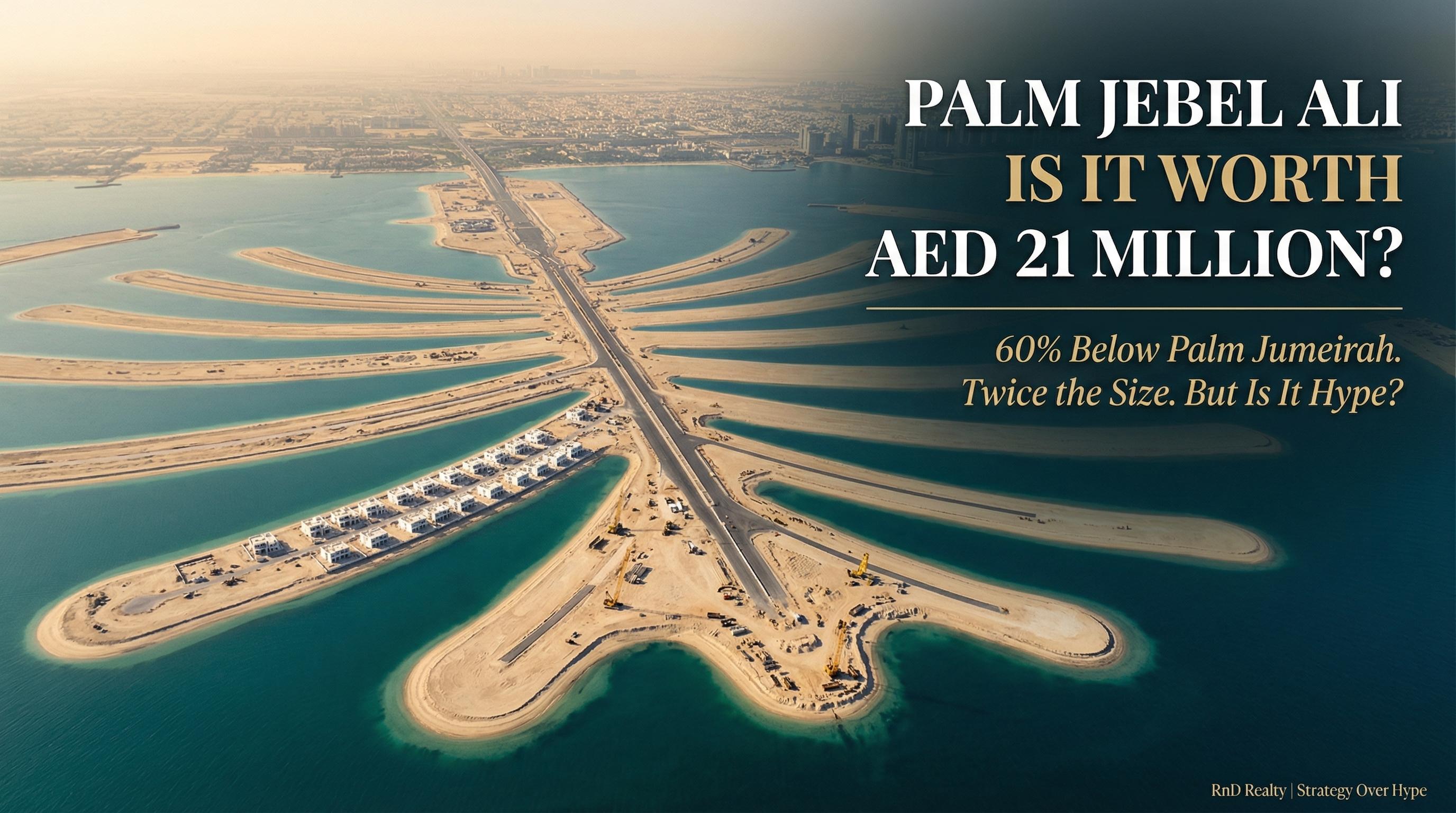
Palm Jebel Ali is twice the size of Palm Jumeirah. It has 110 kilometers of coastline compared to Jumeirah's 78. It will have 90 kilometers of beaches. And it's being built by Nakheel — the same government-backed developer that proved the concept works the first time around.
The numbers already speak. AED 35.1 billion in total sales across 1,632 transactions since the relaunch in October 2023. More than 700 villas sold in Phase 1 within months. Knight Frank reports that Palm Jebel Ali accounted for 10 percent of all Dubai home sales above USD 10 million last year — second only to Palm Jumeirah itself.
And here's the number that has every luxury investor paying attention: Palm Jebel Ali villas are currently priced at AED 2,500 to AED 2,800 per square foot. Palm Jumeirah averages AED 4,250 per square foot. That's a 60 percent discount for an island that's larger, newer, and backed by the same master developer.
So the question every investor is asking: is this the opportunity of the decade, or a trap?
Let's be honest about both sides.
What makes Palm Jebel Ali different from everything else in Dubai
First, understand the scale. Palm Jebel Ali covers 13.6 square kilometers. That's not a tower. It's not a community. It's an entire geography being created from the sea. It includes 16 fronds (residential fingers), a crescent breakwater, a central trunk, and plans for 80 five-star hotels including Six Senses and Atlantis brands.
But here's what separates it from every other mega-project in Dubai right now: density. Palm Jebel Ali will have only 1,789 residential villas across those 16 fronds. Compare that to Palm Jumeirah's 24,632 units across 92 projects. That's 13 times fewer homes on an island that's twice the size.
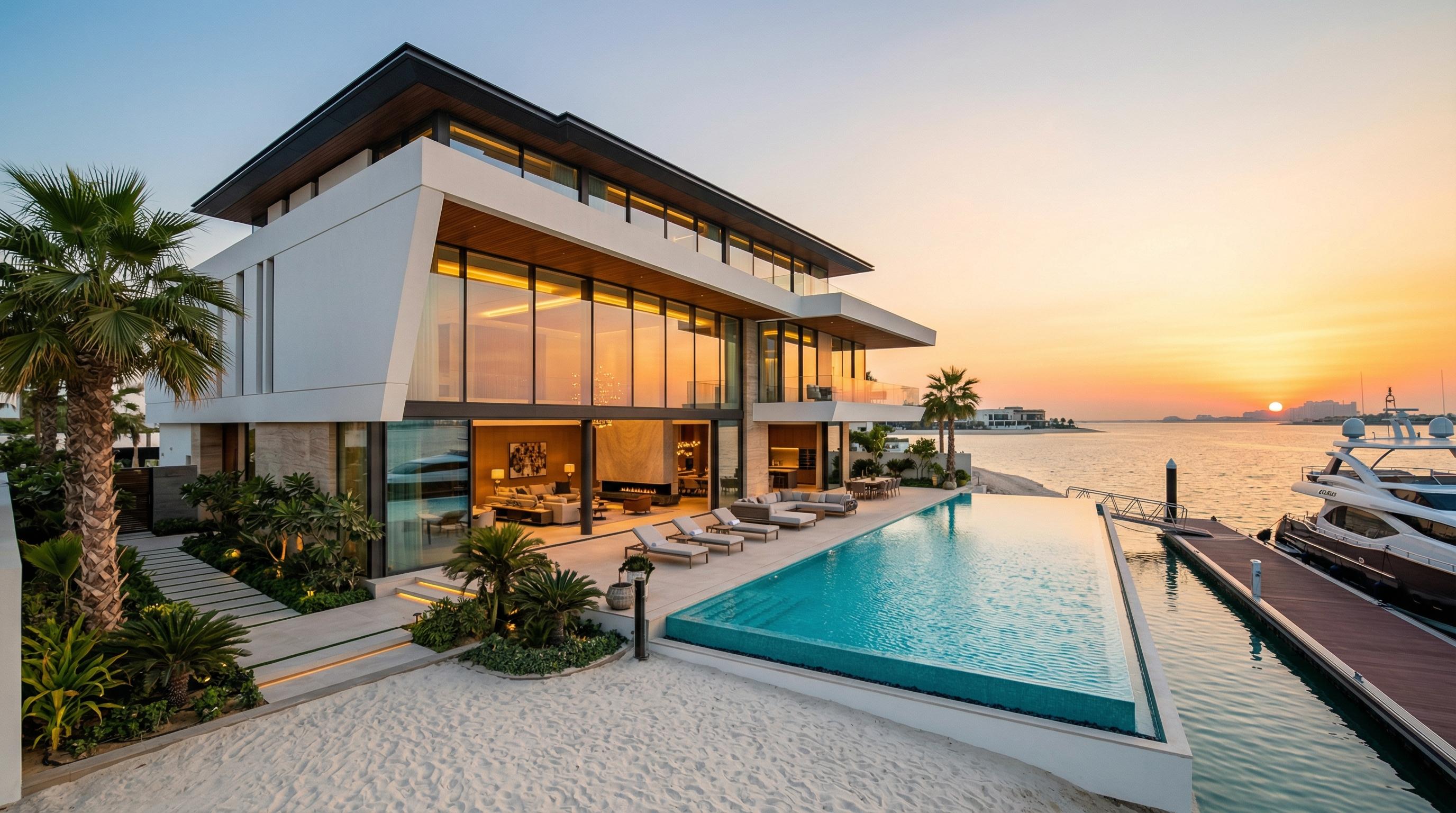
This ultra-low density is deliberate. Nakheel is positioning Palm Jebel Ali as the most exclusive residential address in Dubai — beachfront villas with private access, not apartment towers crammed onto every available plot. From a supply dynamics perspective, this is the exact opposite of the oversupply risk we identified in apartment-heavy areas.
The actual prices and what you get
Five-bedroom villas start at approximately AED 18.5 million. The median price for five-bedroom villas is AED 21.5 million at AED 2,600 per square foot. Six-bedroom villas average AED 21.6 million at AED 2,692 per square foot. Premium seven-bedroom mansions start from AED 43 million. Ultra-luxury plots on select fronds have crossed AED 115 million.
For context, a comparable five-bedroom villa on Palm Jumeirah — if you can find one — would cost AED 35 to 50 million. Palm Jebel Ali villas are also 53 percent larger on average. A typical five-bedroom here is 8,332 square feet compared to 5,457 square feet on Jumeirah.
The payment structure is investor-friendly. Nakheel offers 80/20 plans — 20 percent during booking and construction, 80 percent at handover. This means you can secure a AED 21 million villa with approximately AED 4.2 million upfront and keep the rest of your capital deployed elsewhere until handover in late 2027 or 2028.
Every villa on Palm Jebel Ali qualifies for the Dubai Golden Visa — the investment far exceeds the AED 2 million threshold.
Where construction actually stands
This is where we go beyond the marketing and look at facts from Dubai Land Department inspection reports.
As of the latest inspections, the island-wide average completion stands at approximately 8.7 percent. Frond O is furthest along at 21.9 percent completion. Marine works — dredging, land reclamation, beach profiling, and sand placement — are more than 50 percent complete across multiple fronds. An AED 810 million marine works contract was awarded to Jan De Nul Dredging. An additional AED 5 billion in construction contracts has been awarded to Ginco General Contracting, Shapoorji Pallonji Mideast, and United Engineering Construction Company for 723 villas across six fronds.
Core infrastructure — roads, utilities, shoreline engineering — is targeted for completion by Q4 2026. The first residential handovers are expected by late 2027 for 325 units on Fronds I, J, M, and P. The bulk of the island — 746 units across Fronds A, C, D, E, F, and O — is scheduled for 2028, with final phases completing by 2029-2030.
The construction is backed by AED 17 billion in strategic financing — AED 11 billion refinanced through Mashreq Bank, Dubai Islamic Bank, and Emirates NBD, plus AED 6 billion in additional funds. This is not a project dependent on presales to fund construction. The financial backing is institutional.
The honest bull case
Several factors make Palm Jebel Ali genuinely compelling as a long-term investment.

The price gap to Palm Jumeirah is real and significant. At AED 2,600 per square foot versus AED 4,250, buyers are getting in at 60 percent below the proven benchmark. Analysts forecast 50 to 70 percent price growth over the next few years as construction progresses and amenities materialize. Villa prices have already been increasing 3 to 5 percent per quarter since the 2023 relaunch.
The supply scarcity argument is strong. With only 1,789 total villas planned, compared to the thousands of apartments being dumped into communities like JVC and Business Bay, Palm Jebel Ali will never face oversupply pressure. Every villa is beachfront or near-beachfront. There is no future phase where a developer can build 5,000 studios next door and dilute your value.
Dubai's luxury segment has proven to be the most resilient part of the market during every downturn — including the current regional tensions. While mid-market apartments saw transaction dips during the Iran conflict, ultra-prime waterfront properties barely flinched. As we noted in our rental yields analysis, yield is income but appreciation is wealth. Palm Jebel Ali is purely an appreciation play — and the structural fundamentals support it.
The honest bear case
Now for the part that no other brokerage will tell you.
The handover timeline is ambitious. Late 2027 for the first 325 units assumes zero delays in a project of unprecedented scale. History suggests that delays of 6 to 18 months are common in mega-projects, even with well-funded developers. If you're buying at AED 21 million, your capital could be committed for 3 to 5 years before you see a finished product.
The location is not central. Palm Jebel Ali is 20 kilometers southwest of Dubai Marina, near Jebel Ali Port. It's accessible via Sheikh Zayed Road, but it's not a 10-minute drive to Downtown or DIFC. For residents who work in central Dubai, this is a meaningful daily commute. The area around the island is still developing — it lacks the mature restaurant, retail, and entertainment infrastructure that makes Palm Jumeirah feel lived-in.
Liquidity risk is real. At AED 21 million and above, your buyer pool is extremely narrow. If you need to exit in a hurry, finding a buyer willing to pay AED 20 million or more for a villa on an island that's still under construction isn't easy. This is not a studio you can flip on Property Finder in two weeks.
Rental yield will be modest at best. A AED 21 million villa might rent for AED 800,000 to AED 1.2 million per year once the community matures — but that's a gross yield of 3.8 to 5.7 percent before service charges and management costs. You're not buying this for income. You're buying for capital appreciation and lifestyle.
And finally — the 2008 comparison. Palm Jebel Ali was originally announced in 2002. Land reclamation was completed. Then the global financial crisis hit, and the project was shelved for over a decade. Nakheel nearly went bankrupt. Investors who had bought plots lost access to their money for years. The project is now backed by Dubai Holding with AED 17 billion in financing, which is a fundamentally stronger position. But the institutional memory exists, and some ultra-high-net-worth buyers remain cautious precisely because of that history.
Who this is actually for
Palm Jebel Ali is not for every investor. It's for a specific profile.
You have AED 4 to 5 million minimum for the down payment and can afford to lock up capital for 3 to 5 years. You're buying for long-term appreciation, not rental income. You want ultra-prime waterfront exposure at the earliest possible price point. You already have income-generating assets elsewhere in your portfolio. And you understand that mega-projects carry timeline risks that smaller developments don't.
If that describes you, Palm Jebel Ali is arguably the most compelling early-stage luxury investment in Dubai right now. The combination of government-backed developer, structural supply scarcity, massive price gap to the proven comparable, and institutional financing creates a rare setup.
If your budget is under AED 5 million, or if you need rental income from day one, or if you can't afford to wait 3 to 5 years — there are better options for your specific goals.

The bottom line
Palm Jebel Ali is real. It's under construction. It's financed. And it's selling at a 60 percent discount to the most iconic island in the Middle East.
But "real" doesn't mean "right for you." The difference between a life-changing investment and an expensive mistake comes down to one thing: whether the asset matches your financial reality, your timeline, and your tolerance for risk.
We can help you figure that out.
If you're considering Palm Jebel Ali — or any luxury property in Dubai — talk to our advisory team. We'll give you the analysis, not the sales pitch.
Data sources: Dubai Land Department, Nakheel Properties, Knight Frank, AGBI, Propsearch.ae, The National, Benham and Reeves, Metropolitan Real Estate.
FAQ
Q: How much does a villa on Palm Jebel Ali cost in 2026? A: Five-bedroom villas start from approximately AED 18.5 million. The median price is AED 21.5 million at AED 2,600 per square foot. Six-bedroom villas average AED 21.6 million. Premium seven-bedroom mansions start from AED 43 million.
Q: When will Palm Jebel Ali villas be ready? A: The first 325 villas on Fronds I, J, M, and P are targeted for late 2027 handover. The majority of units across Fronds A, C, D, E, F, and O are scheduled for 2028. Core infrastructure is targeted for Q4 2026 completion.
Q: Is Palm Jebel Ali cheaper than Palm Jumeirah? A: Yes, significantly. Palm Jebel Ali villas average AED 2,600 per square foot compared to AED 4,250 on Palm Jumeirah — approximately 60 percent cheaper. Villas are also 53 percent larger on average.
Q: Is Palm Jebel Ali a good investment? A: For long-term investors with AED 4-5 million minimum capital who can wait 3-5 years, the fundamentals are strong — government-backed developer, ultra-low density (1,789 villas vs Jumeirah's 24,632 units), institutional financing, and a significant price gap to the proven comparable. However, it carries timeline risk and limited near-term liquidity.
Q: What is the payment plan for Palm Jebel Ali? A: Nakheel offers an 80/20 payment structure — 20 percent during booking and construction phases, 80 percent at handover. This means a AED 21 million villa requires approximately AED 4.2 million upfront.
Q: Does Palm Jebel Ali qualify for the Dubai Golden Visa? A: Yes. All Palm Jebel Ali villas exceed the AED 2 million minimum threshold for the 10-year Golden Visa. Buyers can apply for long-term UAE residency for themselves and their families.
Related Posts
 Apr 21, 2026
The 80% Signal: What Dubai's April Data Tells Smart Investors
Off-plan just crossed 80% of Dubai apartment transactions in April 2026. Median price held at AED 1,...
 Apr 07, 2026
We Reviewed 50 Dubai Property Deals This Month | Here Are the 7 Red Flags We Keep Seeing
Our advisory team reviewed 50 property deals brought to us by investors in March 2026. These are the...
 Apr 01, 2026
Priced Out of Dubai? 7 Areas Where You Can Still Buy Under AED 1 Million in 2026
Think you can't afford Dubai property? These 7 areas still offer apartments and townhouses under AED...